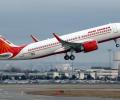
In its first move to significantly expand the fleet after the Tatas took over, Air India has leased 25 Airbus narrow-body aircraft and five Boeing wide-body planes. These will enter service starting December, the company said on Monday. A wide-body plane has a bigger fuel tank, allowing it to travel longer distances such as India-US routes.

Jet Airways has been hit by three top-level resignations ahead of its relaunch. The three senior executives who have resigned include Captains Niraj Chandan (head of flight safety), Vishesh Oberoi (head of operations) and Sorab Variava (head of training). These posts are critical and generally senior pilots are nominated for the roles.

The coming years will be among the most exciting of your professional lives, IndiGo's new chief executive officer (CEO) Pieter Elbers wrote to the airline's staff after taking charge on Tuesday. Elbers, who spent three decades at KLM Royal Dutch Airlines, replaces Ronojoy Dutta at the top post. "Earlier, IndiGo communication summarised it all in just three words: 'Towards new heights' and-let me add here: 'across new frontiers'. "With that vision in mind, you should feel assured that the coming years will be among the most exciting of your professional lives," Elbers said.

'It leads to more investment, more money put in R&D, expansion and modernisation.'

Just a few weeks ago, Communications Minister Ashwini Vaishnaw did some tough talking with the senior managers of Bharat Sanchar Nigam Ltd, the ailing state-owned telecom service provider. The message was clear: They had to perform, quit by taking the voluntary retirement package or be compulsorily retired from service. The terse message from an otherwise polite and soft-spoken minister came just days after he announced a second and bigger package of Rs 1.64 trillion as part of a four-year turnaround plan for BSNL.
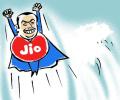
Reliance Jio's aggressive target to reach 100 million households through the launch of the 5G fixed wireless access (FWA) could make it one of the world's largest players in this space. But this also marks a change from its earlier strategy of offering fibre-to-the home (FTTH) broadband to households. Despite its best efforts, in two years Jio has been able to connect only 7 million households with FTTH, as permission for right of way for the last mile became a major impediment and the process of laying ducts for the roll-out was slow and cumbersome.

The merits and demerits of the telcos' 5G strategy however is clearly dependent on the financial muscle of players, reports Surajeet Das Gupta.

commercial airlines and air navigation service providers have to carry out random drug tests on at least 10 per cent of their flight crew and air traffic controllers every year.

Telecom gear makers say will take six to eight months for the top 10 cities to have some reasonable coverage of 5G network services.

ersonnel in a revamp that aims to provide cost-effective, reliable, and professionally competent security service at airports. Aneesh Phadnis reports.

Foundries in Taiwan account for more than 75 per cent of the chips that mobile devices made in India need, according to estimates by the Indian Cellular and Electronics Association (ICEA), which represents global and domestic manufacturers. The number is slightly lower, 60 per cent, if one considers all chips -- those of consumer electronics, PCs, laptops, autos, etc. This ties in with the fact that foundries in Taiwan, led by TSMC, account for over 70 per cent of the world's microchip supply, according to estimates by Gartner.

How dominant are Chinese firms in India's sub-Rs 10,000 mobile device market? The question has become relevant as the government has been thinking of reserving this price segment for domestic players who have not been able to battle the Chinese onslaught. However, telecom firms and others are concerned that such a move could stymie the effort to build affordable 5G phones in the sub-Rs 10,000 category.

'By the end of 2022, we expect the installed base of 5G smartphones in India to reach 80-85 million.'

The Department of Telecommunications (DOT) on Wednesday received over Rs 17,873 crore from companies towards 5G spectrum dues. Nearly half the amount (Rs 8312.4 crore) was paid by Bharti Airtel, which made advance payments for four years to free up cash for future investments. Reliance Jio and Vodafone Idea paid Rs 7,864 crore and Rs 1,680 crore, respectively.

The government is busy strategising ways to revive the domestic mobile device industry as Chinese firms have grabbed a large chunk of the handset market. The idea is to minimise competition from Chinese mobile players in the entry level or sub-Rs 10,000 category, according to a senior government official familiar with the plans. While discussions on the strategy are on, there's a growing consensus within the government that the lower end of the market should be reserved only for the domestic players, the official said.

'There were two options before the government -- create a complex, cumbersome law, which will cause a tremendous amount of compliance challenges for startups or say let's go back and do a clean slate, where we do a framework of laws and policies'

It came as a surprise to all stakeholders - competing telecom companies (telcos), most analysts and even the government's internal projections on revenues from the 5G auctions. Reliance Jio disrupted all calculations by paying a stiff Rs 40,000 crore to buy 10 MHz of spectrum in the 700-MHz band, globally considered a key band for efficient 5G service coverage, along with the default 3.5 GHz band and the ultra-high speed and low-latency millimetre band of 26 GHz band. So what made Jio pay almost 45 per cent of its total spend in this auction for the 700 MHz band - much more than what it rustled up even for the 3.5 GHz band?

A disagreement between mobile operators and device manufacturers over e-SIMs has reached the government with the Cellular Operators Association of India (COAI) asking the DoT to order handset manufacturers to introduce eSIMs, in addition to the physical SIM slot, in all smartphones costing over Rs 10,000. The reason is the unprecedented global shortage of semiconductors which has severely impacted the supply of SIM cards across the globe and pushed up the price by four to five times. The shortage is not likely to improve before 2024.

Reliance Jio's decision to acquire 700 MHz in combination with the possible use of an advanced standalone (SA) 5G network could give it an edge over its rivals, according to most analysts. The dissenters argue that the stiff price tag touching Rs 40,000 crore to grab 10 MHz of spectrum in 700 to provide coverage for its SA 5G network which offers ultra-low latency (unlike non-standalone or NSA), has a long way to go in India in terms of finding use cases that can be monetised. Globally, 700 MHz is a pivotal band which provides huge coverage, indoor penetration (especially useful in India where walls are thick) and is already considered by the European Union to be the 'pioneer band' for 5G, with 3.5 GHz and 26 GHz, both of which were auctioned in India recently.

With Chinese companies Huawei and ZTE excluded from participating in the 5G roll out, their absence leaves a vacuum in the market which will have to be filled by three vendors: Ericsson, Nokia and Samsung.
 © 2026 Rediff.com - Advertise with us - Disclaimer - Privacy Policy - Sitemap - Feedback - About us - Terms of use - Grievances